
Can Solar Panels Be Installed on a Flat Roof?
Many people assume solar panels can only be installed on a pitched roof, and that a flat roof won't receive enough sunlight. In reality, installation of solar panels on a flat roof is completely possible and often works very well.
Solar panel installations on flat roofs are common on commercial buildings, but they are also increasingly used on homes, apartment blocks, and extensions.
With the right mounting system, flat roofs can support an efficient solar PV system that generates clean electricity for decades.
If you have a flat roof and want to install solar panels, there's a good chance it could work just as well as — or sometimes better than — a traditional pitched roof system.
How Do Solar Panels Work on a Flat Roof?
With pitched roof systems, solar panels follow the natural slope of the roof.
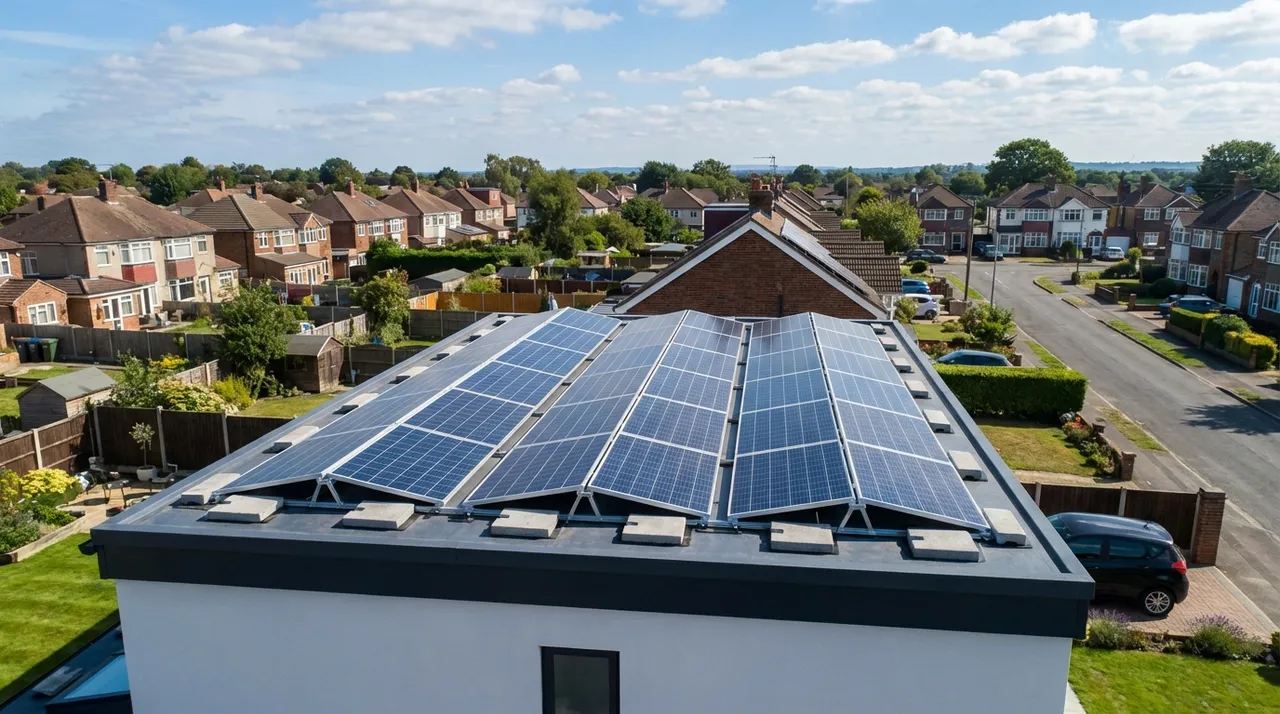
When installing solar panels on flat roofs, installers create their own angle using a specially designed panel mounting frame.
This is actually an advantage because the angle for solar panels can be optimised for maximum solar energy generation.
In the UK, the ideal angle for solar panels is typically around 30–40 degrees. This allows panels to capture more sunlight throughout the day and improves overall solar PV output.
Flat roof systems achieve this using tilted mounting brackets or metal frames. These hold the panels at the correct angle while keeping them securely attached to the roof structure.
Because the angle is adjustable, installers can design the solar system to perform efficiently regardless of the building.
How Are Flat Roof Solar Panels Mounted?
Most panels on flat roofs are installed using a ballasted mounting system.
This means the system is held in place using weight rather than drilling directly into the roof. The frames are secured using ballast such as:
- Concrete blocks
- Gravel
- Paving slabs
- Weighted trays
- Ballasted frames with added weight
- Aerodynamic mounting systems
- Mechanical fixings attached to the building structure
- The property is a listed building
- The home is located in a conservation area
- The installation extends beyond the roofline
- Residential homes
- Apartment buildings
- Extensions and garages
- Commercial buildings and warehouses
- A 4kW solar system usually needs 20–30 m² of roof space
- Larger systems will require proportionally more space
- Ballasted mounting systems
- Fixed mounting frames
- System size
- Roof structure
- Mounting system used
- Battery storage options
- Reduce electricity bills
- Generate renewable solar energy
- Lower your carbon footprint
- Provide long-term energy savings
This method protects the roof surface while still keeping the system stable in high winds.
In some situations, especially on smaller roofs or where weight restrictions apply, installers may use a fixed mounting system attached directly to the building structure.
The choice of panel mounting method depends on factors such as roof strength, wind exposure, and the design of the building.
Benefits of Solar Panels on Flat Roofs
Flat roofs actually offer several advantages when installing solar PV panels.
Optimised Panel Angle
Because installers create the angle themselves, the angle for solar panels can be set for maximum sunlight exposure rather than being limited by the roof slope.
Discreet Installation
Solar panels on flat roofs are often less visible from street level, making them a popular option for homeowners who want a more subtle solar setup.
Flexible Panel Layout
Flat roofs provide more flexibility when designing the solar array, including layouts such as east west systems that maximise energy generation across the day.
Easier Installation and Maintenance
Flat roofs are generally easier and safer to access, which simplifies both installation and long-term maintenance.
Clean Renewable Energy
Installing solar PV allows homes and businesses to generate clean solar energy, reduce reliance on fossil fuels, and lower their electricity bills.
Disadvantages of Flat Roof Solar Panels
Although flat roof systems have many advantages, there are also a few considerations.
More Space Required
Flat roof solar panel installations usually require more roof space per kilowatt compared with pitched roof systems. This is because rows of panels must be spaced apart to prevent one row shading another.
Structural Weight
Ballasted systems add weight to the roof. Before installing solar panels, the building structure must be checked to ensure it can support the solar mounting system.
A professional installer will assess the roof during the survey stage.
What Angle Do Flat Roof Solar Panels Need?
For good performance, solar panels on flat roofs should be tilted at least 10 degrees.
This angle allows rainwater to wash dirt from the panel surface and helps maintain efficiency.
Most UK solar PV roof systems are installed between 20 and 40 degrees, depending on the available space and design of the system.
Angles closer to 30–40 degrees often produce the best annual energy generation in the UK.
How Wind Affects Solar Panels on Flat Roofs
Because flat roofs are more exposed, wind load is an important design factor.
Installers use several methods to ensure the solar mounting system remains secure:
A professional installer will design the system based on the building height, location, and wind exposure.
Will Solar Panels Affect My Roof Warranty?
Many modern roofs allow ballasted solar mounting systems without affecting the existing roof warranty.
However, if the system is fixed directly into the roof structure, the warranty conditions should always be checked beforehand.
A qualified installer will normally assess this during the survey stage before proceeding with the solar panel installation.
Can Solar Thermal Panels Be Installed on a Flat Roof?
Yes. In addition to solar PV panels, solar thermal panels can also be installed on flat roofs.
Solar thermal systems use sunlight to heat water rather than generate electricity, and they use a similar panel mounting system to achieve the correct angle.
Do Flat Roof Solar Panels Need Planning Permission?
In most cases, solar panel installations fall under permitted development in the UK.
This means planning permission is usually not required when installing solar panels on residential buildings.
However, planning permission may be required if:
If you are unsure, it is best to check with your local planning authority before installing solar panels.
Are Flat Roof Solar Panels Worth It?
For many homes and commercial buildings, flat roof solar panels are an excellent option.
They provide flexibility in panel placement, allow installers to optimise the angle for solar panels, and can deliver strong energy production when designed correctly.
With electricity prices rising and demand for renewable solar energy growing, installing solar PV on flat roofs is becoming an increasingly popular way to generate clean electricity and reduce long-term energy costs.
Flat Roof Solar Panels FAQs
Can you put solar panels on a flat roof?
Yes. Solar panels can absolutely be installed on flat roofs, and in many cases they perform just as well as systems on pitched roofs.
Instead of following the slope of a roof, installers use a solar mounting system that tilts the panels at the correct angle. This allows the panels to capture more direct sunlight and maximise solar energy production.
Flat roof solar systems are widely used across the UK on:
With the correct panel mounting frame, flat roofs can support a highly efficient solar PV system.
Are solar panels on flat roofs less efficient?
No. In some cases, solar panels on flat roofs can actually perform better than panels on pitched roofs.
This is because the installer can choose the optimal angle for solar panels, typically between 30 and 40 degrees, which is ideal for UK solar irradiance levels.
With pitched roofs, panels must follow the roof slope even if the angle is not ideal.
Flat roofs allow installers to optimise the solar array layout, sometimes using east west systems to capture sunlight across more hours of the day.
How much space do flat roof solar panels need?
Flat roof solar installations usually require slightly more roof space than systems installed on pitched roofs.
This is because rows of panels must be spaced apart to avoid shading.
As a general guide:
The exact layout depends on the mounting system, roof orientation, and angle of the panels.
Are flat roof solar panels safe in strong winds?
Yes, when designed correctly.
Professional installers calculate wind loads carefully and use either:
Ballasted systems use heavy weights to secure the solar mounting structure, while fixed systems anchor the panels directly to the roof.
Both options are designed to ensure the system remains secure in high winds.
Do flat roof solar panels cost more?
In most cases, installation costs are similar to pitched roof systems, although flat roof systems may require slightly more equipment due to the panel mounting frames and ballast.
However, flat roofs often make installation easier because they provide better access and working space.
The overall solar panel installation cost will depend on:
Are flat roof solar panels worth it?
For many properties, flat roof solar is an excellent option.
A properly designed solar PV system can:
With electricity prices continuing to rise, installing solar panels on flat roofs is becoming an increasingly practical way for households and businesses to produce their own clean energy.