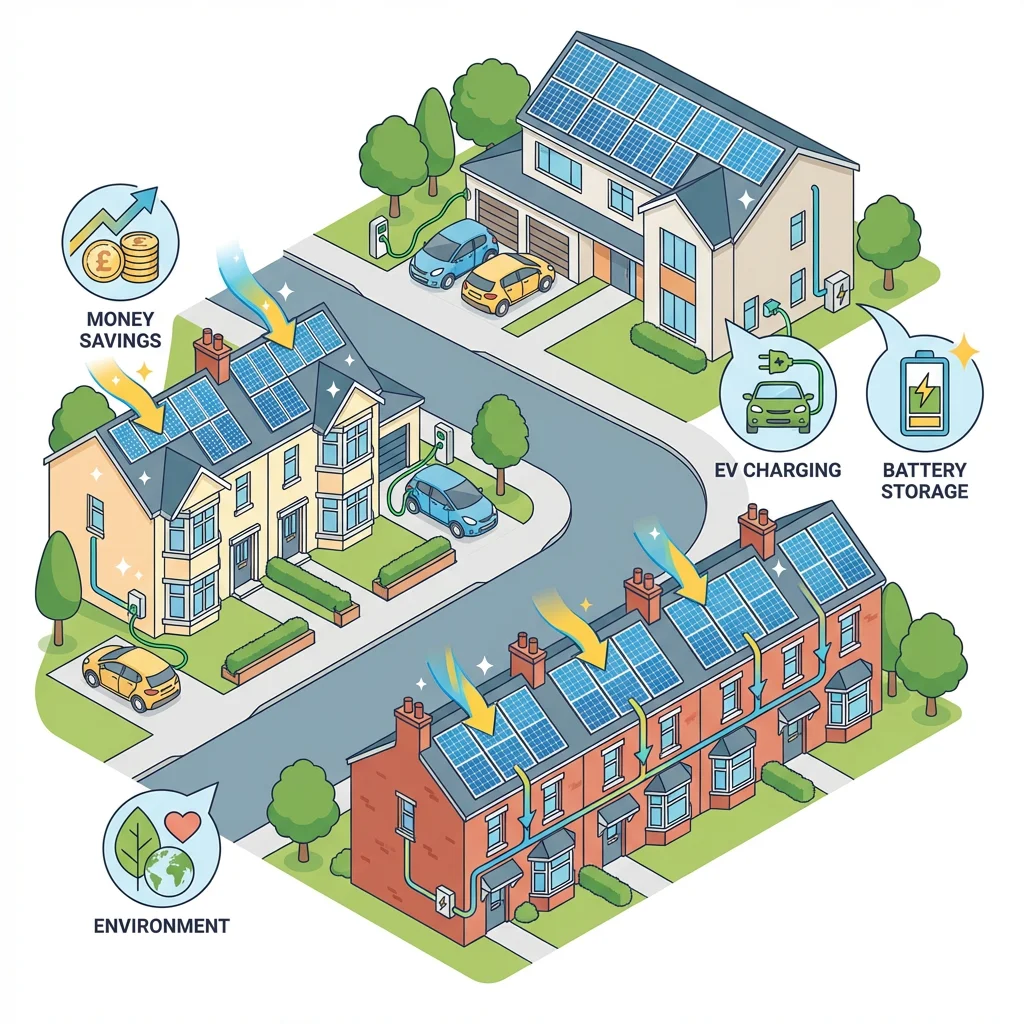
Solar panels are becoming one of the most popular ways for UK households to lower electricity bills, reduce their carbon footprint, and take control of their energy. With solar installations increasing every year, many homeowners are now using solar energy to power their homes and generate free energy from the sun.
Solar panels harness the sun's energy to generate electricity for residential use, providing a renewable and clean energy source. Modern solar panels perform well even in low-light conditions and are ideal for homes with limited roof space. Leading solar panels in 2026, such as AIKO NeoStar 3P or RECOM Black Tiger, have achieved efficiencies of up to 25%.
This guide explains how solar panels work, the benefits they offer, and what to expect if you're considering a solar system for your household.
What are solar panels?
Solar panels are roof-mounted systems that capture sunlight and convert it into electricity for your home, generating energy by absorbing sunlight through photovoltaic cells. This process produces solar electricity that can be used for everyday needs. They generate direct current, which is then changed into alternating current so it can be used for everyday electricity use.
To generate optimal solar power, it's best to install solar panels on a south-facing roof with a tilt of 30 to 45 degrees; east or west-facing roofs can still generate energy but may produce 15-20% less.
Solar panels work whenever the sun shines, even on cloudy days. A typical solar system can power appliances, lighting, and heating controls, while reducing the amount of electricity you buy from the grid. For UK homes, monocrystalline panels are recommended due to their high efficiency and suitability for typical roof sizes. For optimal energy generation, homeowners should look for solar panels with efficiency ratings of at least 20%.
Over 1.4 million UK homes already use solar panels to generate greener electricity.
Can I save money with solar panels?
Many households can lower electricity bills by generating their own power. In 2026, a typical UK household with a 3.5kWp solar system can save between £190 and £350 annually on electricity bills, with the typical bill calculated using the national average October electricity price cap. Savings depend on how much energy your system produces, how much electricity you use during the day, and whether you store extra electricity in a solar battery.
You can save on average over £500 per year by using solar panels, depending on your electricity use and system size. Typical bill savings can exceed £500 per year, although actual savings vary by region and roof aspect. Generating more electricity at home means buying less from your energy supplier, which can protect you from rising prices.
How do solar panels help the environment?
Solar panels reduce your carbon footprint by producing energy without burning fossil fuels. This cleaner energy helps cut greenhouse gas emissions and supports the move towards greener electricity across the UK.
By switching to solar energy, households reduce their reliance on traditional power sources and contribute to a more sustainable energy system.
How are solar panels installed on a home?
Most solar panels for households are ideally installed on a sloping roof, as panels work best when angled towards the sun and are not shaded by trees or other buildings. Many installations are carried out by independent installers operating under an upfront payment model. Solar experts or a professional solar installer will assess your roof's aspect, available space, and determine the best installation approach to ensure optimal performance.
You should consult your local planning office to check if you need planning permission to install solar panels, especially if your property is listed or your roof faces north. Installers usually install scaffolding before the installation date, and in some cases, additional scaffolding may be needed.
Your solar panel system needs to be registered with your local Distribution Network Operator (DNO). The average installation time for solar panels is usually only one day.
At the end of the installation, your solar panel installer should leave written details of any maintenance checks you should make to ensure everything is working properly.
What are my solar panel installation options?
When it comes to installing solar panels, UK homeowners have a range of flexible options to suit different needs and budgets. The most common choice is a roof-mounted solar panel system, which allows you to generate free energy from the sun and significantly lower your electricity bills. Thanks to advancements in solar technology, panels can now be installed on a variety of roof types—including north-facing roofs—so more households can benefit from solar energy, regardless of their roof aspect.
For those looking to maximize their savings and reduce their reliance on the grid, adding battery storage to your solar panel system is a smart move. A solar battery lets you store excess solar energy generated during the day, so you can use it in the evening or during cloudy periods, reducing your reliance on the grid and helping you make the most of your solar installations.
Financial flexibility is another key advantage. If the upfront cost of solar panels is a concern, there are several ways to make solar more affordable. Many independent installers operate an upfront payment model, but you can also explore finance options with fixed interest rates and repayment periods, making it easier to spread the cost. Government schemes and financial support are available to help with installation costs, and some energy suppliers offer additional incentives. For example, the Hive Solar Saver discount can give you up to 25% off your electricity unit rate on any British Gas tariff, making your switch to solar even more cost-effective.
Another way to boost your savings is through the Smart Export Guarantee (SEG). This scheme allows you to sell surplus electricity—any extra energy your solar system generates but you don't use—back to the grid. Not only does this help lower your energy bills, but it also means you're contributing greener electricity to the national supply.
Choosing the right solar panel installer is crucial for a successful installation. Look for experienced, reputable companies or independent installers with strong reviews and a track record of quality solar installations. A good solar panel installer will assess your home's energy needs, roof aspect, and shading to design a system that delivers the best performance for your household.
With so many options available, from battery storage to export tariffs and flexible payment models, installing solar panels is more accessible than ever. Take the time to research, compare installers, and explore government schemes to find the best solar panel system for your home. By making the switch, you'll enjoy lower energy bills, a reduced carbon footprint, and greater control over your household energy.
Can I earn money from excess solar energy?
Yes. If your system produces excess energy—electricity generated beyond your household needs—it can be sent back to the grid. Through an export tariff, you can sell electricity and receive export payments for each unit sent back to the grid.
You can earn money by selling excess energy generated by your solar panels back to the grid through specific tariffs or programs.
Some households also benefit from offers such as Hive Solar Saver or a British Gas tariff, which can further reduce electricity costs.
Do solar panels increase home value?
Solar panels can improve your home's EPC rating, making it more attractive to buyers. Homes with better energy efficiency often sell faster and at higher prices. Research by the Urban Big Data Centre at the University of Glasgow found a price premium of around 6-7% for homes with solar panels, though any uplift varies by property and local market conditions.
A solar system is seen as a long-term improvement that provides lower electricity bills and reduced reliance on the grid.
Can solar panels reduce my reliance on the grid?
Solar panels allow you to generate your own energy and rely less on the grid. With smart controls and apps like the Hive app, you can centrally monitor and manage your solar energy system, including real-time performance tracking, energy export, and storage, to make the most of the power you produce.
This reduced reliance on the grid can be especially valuable during periods of high energy prices or increased electricity demand.
Can solar panels power electric vehicles and other technology?
Yes. Solar panels can power electric vehicles, helping you reduce charging costs and emissions. They can also support heat pumps and other low-carbon technologies.
Using solar energy for transport and heating increases how much energy you use at home and improves overall savings.
Should I add a solar battery?
A solar battery stores extra electricity generated during the day so it can be used later. Solar panels and battery systems help households use more of their own energy and reduce reliance on the grid.
Battery storage is especially useful in the evening when electricity use is higher but solar generation is lower.
How can I manage my solar energy smartly?
Smart apps such as Hive Solar allow you to track how much energy your system generates and how much electricity you use. Real-time data helps you understand how much energy you produce, store, and export.
This makes it easier to adjust habits and maximise savings.
Can solar panels work with heat pumps?
Yes. Heat pumps can be powered by solar energy, providing efficient heating while reducing reliance on fossil fuels. Combining solar panels with heat pumps creates a low-carbon heating solution for modern homes.
Do solar panels need much maintenance?
Solar panels require very little maintenance. Keeping nearby trees trimmed helps prevent shading, and UK rain usually cleans panels that are tilted at 15 degrees or more.
With basic care, solar panels can last 25 years or longer.
How much does it cost to get started with solar panels?
Installation costs depend on system size, roof type, and whether you include a solar battery. The solar panels cost can also be affected by factors such as additional batteries and installation conditions. The total price may increase if extra scaffolding is required.
The average cost of a domestic solar panel system in the UK is around £6,100.
You can finance your solar installation with options like fixed-rate loans over several years.
A solar subscription service is also available, allowing customers to access solar panel installations with low or no upfront costs, paying a regular monthly fee instead.
Many homeowners choose an upfront payment model, while others use green loans with a fixed interest rate to spread costs.
Is there financial support for solar panels?
Financial support is available through schemes such as the Smart Export Guarantee and green loans. Some providers also help homeowners register interest in export tariffs and explain eligibility requirements, including any months advance notice needed.
There are no dedicated solar panel grants from the UK Government, but funding may be available through other government schemes. You can get financial help for solar panels through government schemes like the Energy Company Obligation (ECO), and low-income or fuel-poor households may qualify for 100% funding under the ECO4 scheme, which runs until March 31, 2026. Solar panels and batteries installed in homes have a zero rate of VAT. The Microgeneration Certification Scheme (MCS) accreditation is required for installers to access government incentives such as the Smart Export Guarantee (SEG). In Northern Ireland, you may need to register your solar panel system with the local network operator, and specific financial support may be available through local government schemes.
Do solar panels really provide free energy?
Once installed, solar panels generate free energy from sunlight. This reduces electricity bills, lowers your reliance on the grid, and helps households use more electricity without extra cost.
Conclusion
Solar panels are a reliable and cost-effective way for households to generate solar energy, lower electricity bills, and reduce their carbon footprint. Whether combined with a solar battery, electric vehicles, or heat pumps, a well-designed solar system can deliver long-term savings and cleaner energy for years to come.