
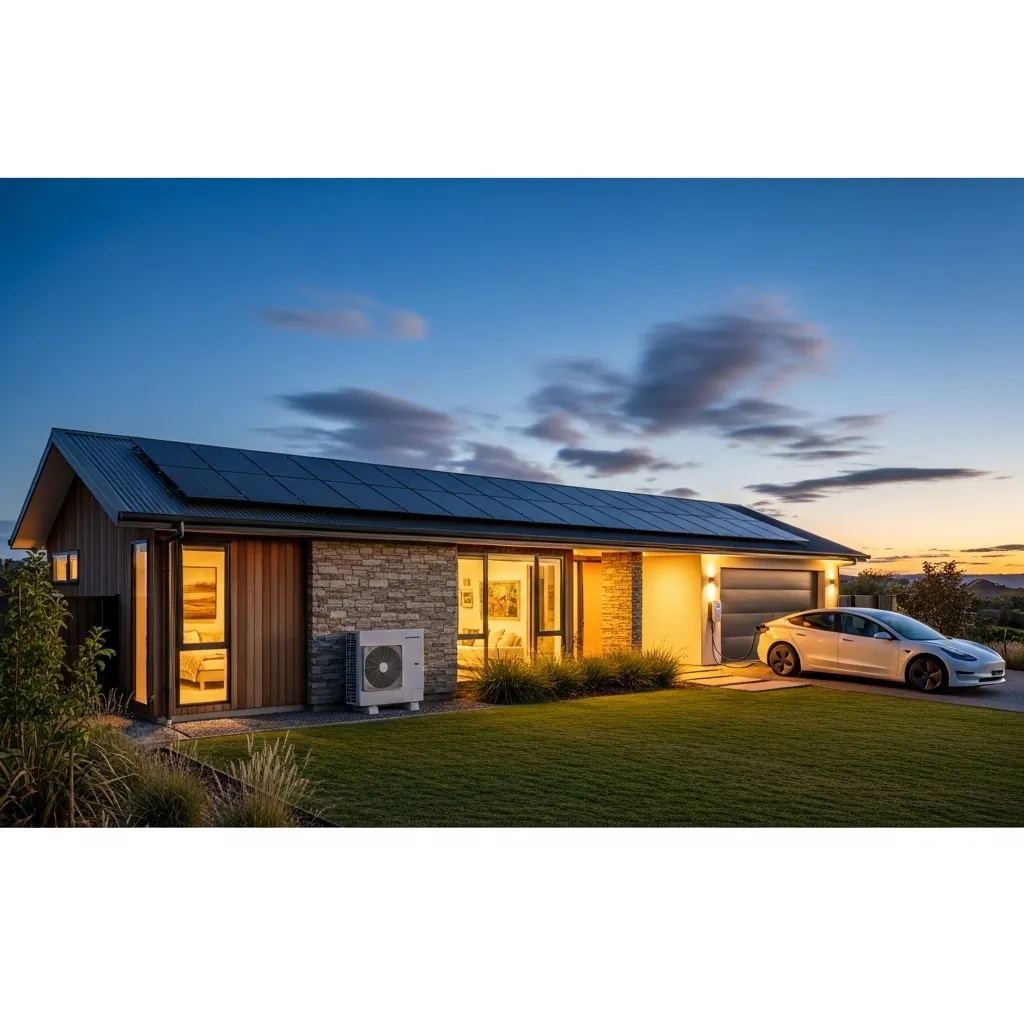
Three technologies now combine to cover most of a home's energy needs: solar panels generate electricity during the day, a battery stores what you don't immediately use, and a heat pump replaces your gas boiler for heating and hot water. Each works independently; together they cut grid dependence significantly and protect against future energy price rises.
This guide covers costs, savings, and what to expect from each technology in 2026.
Solar Panels
A south-facing 4kW system generates around 3,200-3,600 kWh per year in Hampshire - enough to cover roughly 50-70% of a typical household's electricity use before adding battery storage. Hampshire's location in the south of England means better-than-average UK solar yields.
View our solar panel installation service
Panel types in 2026:
| Type | Efficiency | Lifespan | Best for |
| Monocrystalline | 20-24.8% | 30-40 years | Limited roof space, maximum output |
| Polycrystalline | 15-17% | 20-25 years | Larger roofs, tighter budgets |
| Thin-film | 10-12% | 15-20 years | Complex roof shapes, partial shading |
Cost: £6,000-£8,000 fully installed for a 4kW system, including 0% VAT (confirmed until March 2027).
Payback: 7-10 years at the current Ofgem electricity rate of 24.5p/kWh, with SEG export income on top.
Smart Export Guarantee (SEG): You earn a per-unit payment for every kWh you export to the grid. Best fixed rates in 2026 are 25p/kWh (Good Energy) and 24p/kWh (EDF), but these top rates are limited and conditional - they're often only available if you buy your solar system from that supplier, and most widely-available SEG rates are lower. Rates vary by supplier and change over time. A 4kW system without battery storage typically exports around 1,700 kWh per year, earning £100-£250 annually depending on your tariff, system generation and energy costs at the time.
Battery Storage
A battery stores surplus solar generation for use in the evening rather than exporting it at lower SEG rates. Self-consumption rises from around 40-50% without a battery to 70-80% with one.
Popular systems in 2026:
| System | Capacity | Warranty |
| Tesla Powerwall 3 | 13.5kWh | 10 years |
| GivEnergy All-in-One | 9.5kWh | 12 years |
| Enphase IQ Battery | 5kWh (modular) | 15 years |
Cost: £2,500-£6,500 installed depending on capacity. Adding battery storage at the same time as solar reduces overall installation costs compared to adding it later.
View our battery storage service
Air Source Heat Pumps
An air source heat pump replaces your gas boiler, providing central heating and hot water. It runs on electricity rather than gas and delivers 3-4.5 units of heat for every unit of electricity it uses - a seasonal efficiency of 300-450% versus around 90% for a gas boiler.
At current Ofgem rates (electricity 24.5p/kWh, gas 6.4p/kWh), running costs sit close to parity with gas on a standard tariff. On a heat pump-specific tariff like Cosy Octopus, electricity for heat pump use is cheaper, improving the saving. Pairing a heat pump with solar panels means some of your heating runs on free solar electricity, which strengthens the financial case considerably.
Cost before grant: £8,000-£15,000 installed.
Boiler Upgrade Scheme (BUS): £7,500 grant for eligible homeowners in England and Wales, applied directly to the installation cost. After the grant, most installations cost £500-£7,500.
Ground source heat pumps are more efficient (400-500% seasonal efficiency) but cost £20,000-£30,000 before grant due to groundworks. The £7,500 BUS grant applies to ground source too.
View our heat pump installation service
Combined System Costs (2026)
| Package | Typical cost | After grants |
| 4kW solar + 5kWh battery | £10,000-£12,000 | £10,000-£12,000* |
| 6kW solar + 10kWh battery | £14,000-£17,000 | £14,000-£17,000* |
| Air source heat pump only | £8,000-£15,000 | £500-£7,500 |
| 4kW solar + battery + heat pump | £18,000-£27,000 | £10,500-£19,500 |
Annual savings for a full system (solar + battery + heat pump in a typical Hampshire home): £1,200-£2,500 depending on usage, system size, and tariff. Payback on the full package typically runs 9-13 years.
Financing Options
Cash purchase gives the cleanest long-term savings - no interest costs.
0% finance spreads the cost over 3-7 years with no interest, available through some installers and green finance providers.
Warm Homes Plan (replaced ECO4 in April 2026): 0% interest loans for eligible homeowners, plus fully funded packages worth up to £30,000 for low-income households. Nation-specific schemes cover Wales (Warm Homes Nest), Scotland (Home Energy Scotland), and English local authorities (Warm Homes Local Grant).Check your eligibility for the Warm Homes Local Grant.
Green mortgages: Some lenders offer improved rates for energy-efficient properties. Worth checking if you're remortgaging alongside a renewable energy installation.
Property Value
Solar panels add around 1-2% to property value based on Solar Energy UK research - approximately £2,000-£5,000 on a typical Hampshire home. Properties with improved EPC ratings are increasingly attractive to buyers and may qualify for better mortgage rates. A heat pump combined with solar panels typically pushes an EPC from D to B or C, which matters for buyers and for future rental compliance requirements.
What to Check Before You Install
Roof suitability for solar. South, east, or west-facing roofs all work. North-facing panels rarely make financial sense. Your roof should be in good condition - replacing tiles after solar installation is disruptive and expensive.
Heat pump radiator compatibility. Heat pumps work at lower flow temperatures than boilers. Some older radiators need upgrading to deliver adequate heat at 45°C. A proper heat loss calculation before installation tells you exactly which ones need changing.
Electrical capacity. Adding a battery, heat pump, and EV charger to a property with an older consumer unit may require an upgrade. Your installer checks this during the survey.
Planning permission. Most solar and heat pump installations are permitted development. Listed buildings and conservation areas are exceptions - confirm before proceeding.
Installer Credentials to Check
MCS certification is the baseline requirement for solar and heat pump installers. It's mandatory for BUS grant eligibility and SEG registration, and ensures the installer meets industry standards for design and installation.
HIES or RECC membership provides additional consumer protection, including deposit protection and an independent dispute resolution service.
NICEIC approval covers the electrical work involved in both solar and battery installations.
Ask any installer for local references and check recent reviews independently. Getting three quotes is worthwhile - pricing varies and so does system design quality.
FAQ
Do solar panels work in UK weather? Panels generate electricity from daylight, not direct sunshine. Output drops on heavily overcast days but doesn't stop. Hampshire's southern location gives it better-than-average UK yields - around 10-15% more annual generation than Scotland.
Can I add battery storage later? Yes, though it costs more than installing it alongside the panels. Some inverters are "battery-ready" and simplify the retrofit; others need replacing. Confirm battery compatibility when choosing your inverter.
Is 2026 a good time to invest? Electricity prices are high, the BUS grant remains at £7,500, 0% VAT runs until March 2027, and the Warm Homes Plan has opened new funding routes. Panel and heat pump costs have stabilised after several years of falling. There's no strong reason to wait.
How long do these systems last? Solar panels: 30-40 years (25-year performance warranty standard, 40 years from premium brands). Inverters: 10-15 years. Batteries: 10-15 years or around 4,000 charge cycles. Heat pumps: 20+ years with annual servicing.
CRG Direct has been installing solar, heat pumps, and battery systems across Hampshire since 2017. MCS Certified, HIES Accredited.
Contact us for a free site survey and quote. We'll respond within one working day.