
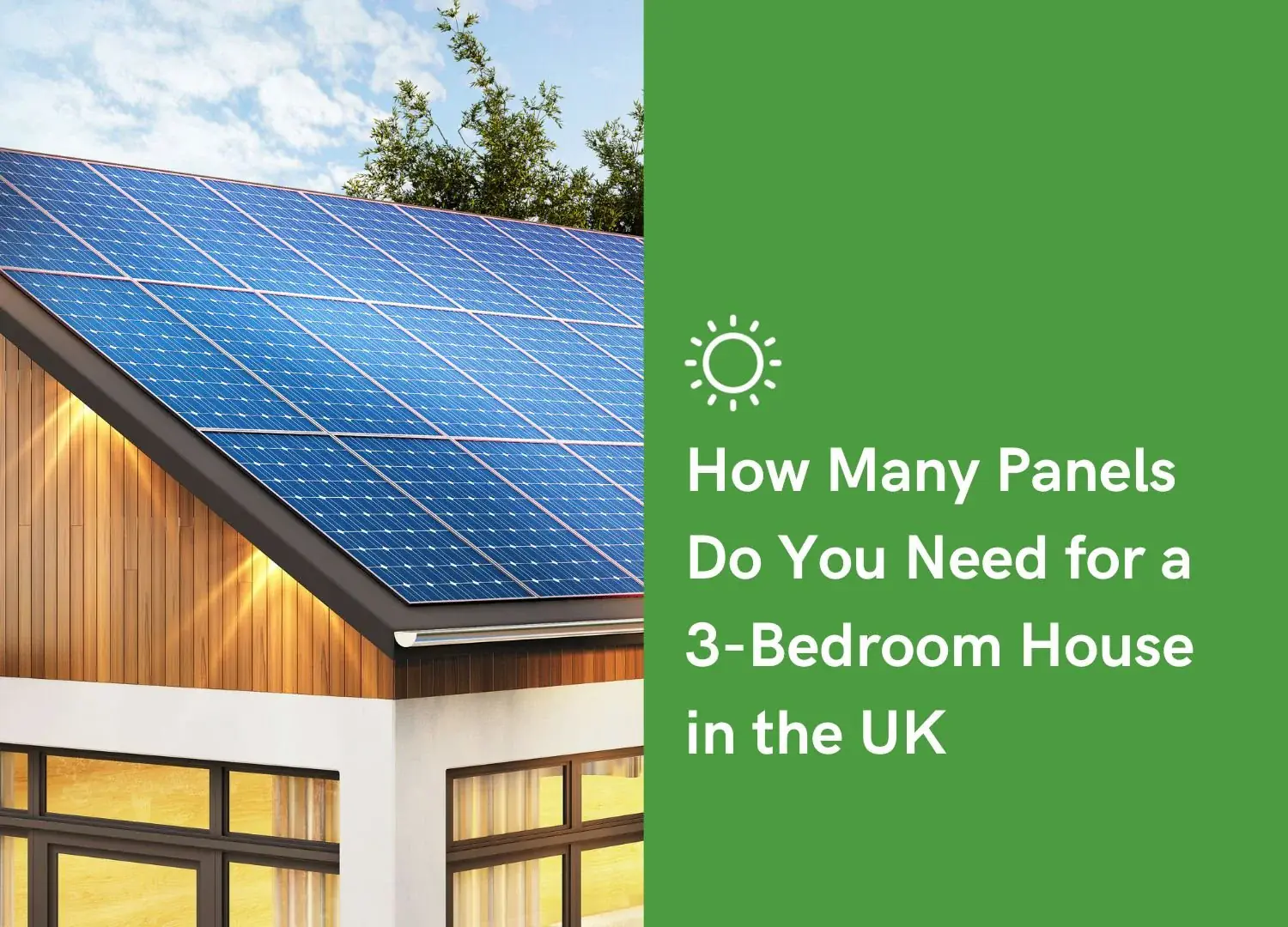
How Many Solar Panels for a 3-Bedroom House in the UK?
Most 3-bedroom UK homes need 8-12 panels, which is roughly a 3.5-5kW system. A typical 3-bed uses around 2,700-3,500 kWh a year, and 8 panels at 400W cover a good share of that. If you charge an EV or run a heat pump, you'll need more.
This page focuses on the 3-bed case. For other house sizes, see our main guide to how many solar panels you need.
What size system suits a 3-bedroom house?
A 3.5-5kW system fits most 3-bed homes. The right figure depends on your annual electricity use, which you'll find on your bills or smart meter app.
A standard 400W panel generates around 340-400 kWh a year under average UK conditions. Output is higher in summer and lower in winter, so your total varies across the seasons. Work out your annual usage, divide by the per-panel output, and you have a starting panel count. An installer refines it for your roof and shading.
| Annual usage | System size | Panels (400W) | Likely fit |
| ~2,700 kWh | 3.2 kW | 8 panels | Lower-usage 3-bed |
| ~3,000 kWh | 3.5-4 kW | 9-10 panels | Average 3-bed |
| ~3,500 kWh | 4.5-5 kW | 11-12 panels | Higher-usage 3-bed |
| + EV or heat pump | add 1.2-2.4 kW | add 3-6 panels | - |
Should I add a battery?
For most 3-bed homes, a battery is worth considering. It stores daytime generation for use in the evening, so you rely less on the grid when your panels aren't producing. Prices have come down and efficiency has improved, which makes the pairing more attractive than it was a few years ago. Whether it's right for you depends on your usage pattern and how much of your generation you'd otherwise export.
How much roof space do you need?
A 3.5-5kW array needs roughly 13-20m² of usable roof. Chimneys, vents and dormers eat into that, so the usable area matters more than the total roof size. If space is tight, higher-efficiency panels (22%+) get more output from the same area, so you may need fewer of them.
What affects output on a 3-bed roof?
Orientation. South-facing gives the best annual output. East or west-facing roofs generate around 15-20% less, so you might add a panel or two to match. North-facing isn't worth fitting. More detail in our guide to the best direction for solar panels.
Pitch. A 30-40 degree pitch is close to ideal, which covers most UK pitched roofs. Flat roofs need angled mounting frames.
Shading. Trees and neighbouring buildings cut generation during the hours they shade the roof. A proper survey models this across the day and seasons, because winter sun sits much lower than summer sun.
Location. Southern homes get more peak sun hours than those further north, so the same system generates a little more in Hampshire than in Scotland.
What does it cost, and what could it save?
A typical 3-bed system runs in the region of £6,000-£9,000 installed, depending on panel choice, whether you add a battery, and access. Savings depend on your usage, your generation and energy prices at the time, so they vary home to home. You can also earn from exported electricity through the Smart Export Guarantee. For current figures see our guide to solar panel costs in the UK.
Solar can also affect resale value. Research by the Urban Big Data Centre at the University of Glasgow found homes with solar attracted a premium of around 6-7%, though any uplift varies by property and local market.
Do I need planning permission?
For most standard pitched roofs, no. Solar panels are permitted development in England and Wales. Listed buildings and some conservation areas are exceptions, and your installer will confirm before quoting.
FAQ
Is 8 panels enough for a 3-bed house? For a lower-to-average usage 3-bed, yes, 8 panels (3.2kW) cover a good share of daytime electricity. Higher-usage homes, or those adding an EV or heat pump, will want 10-12 or more.
How long do solar panels last? Most panels carry 25-year-plus performance guarantees and keep working well beyond that, with output tapering gradually over time.
Do solar panels need much maintenance? Very little, mostly occasional cleaning and the odd check. Costs are low relative to the energy they generate.
Get a tailored figure for your home
The fastest route to an accurate answer is a proper assessment of your roof, orientation, shading and bills.
CRG Direct offers free, no-obligation quotes across Hampshire, Guildford and the South Coast. MCS-certified engineers, HIES accredited.
Contact us for a free quote. We'll get back to you within one working day.
Sources
- Urban Big Data Centre, University of Glasgow, research behind the ~6-7% solar property-price premium: How do solar panels affect property prices in the UK?.
- Ofgem, Smart Export Guarantee (SEG): official scheme page.